

Water activity is a measure of the energy state of water in a system. The system might be a piece of cake, a bag of dog kibble, or a sample of dried cannabis flower.
On one end of the energy spectrum is pure, free water, unaffected by any chemical or physical bonds.
The energy of this water can be reduced in several ways. Imagine dipping a sponge into the water. The free water will move into the sponge – water always moves from high energy (high water activity) toward lower energy.
Within the sponge, the water is bound by hydrogen bonds, capillary forces, and van der Waals-London forces. These are called matric effects. The water in the sponge has a lower energy state than the pure, free water. One way to understand this is by realizing that in order to return the water to its free state, one would have to input work by squeezing the sponge.
Water in the sponge has a lower vapor pressure, lower freezing point, and higher boiling point than pure, free water. We can measure and quantify these differences. The way we measure and describe them is through water activity.
Note that water’s energy (water activity) can also be decreased by diluting it with solutes. Just like with the sponge, work would be required to remove the solutes and return the water to its free state.
Water activity is the sum of matric and osmotic effects.
Water activity is a unitless measurement. The water activity is defined as 1.00 aw. It is important to note that because the full range of water activities is compacted into the space between 0 and 1.0, changes out to the third decimal place can be consequential.
Water activity is a function of temperature. The temperature of the sample should be monitored and accounted for in all water activity measurements. For the most accurate measurements, temperature must be well controlled.
Learn more about water activity and microbial growth in the following 30-minute webinar. In it, you will learn:
- What you need to know about how water activity predicts microbial growth
- How to use specific organism aw limits relevant to cannabis in setting your specs
A scientific definition of moisture content
Moisture content (or water content) is defined as the percentage of a product’s weight that is composed of water. It can be reported on either a wet basis, where the amount of water is divided by the total weight of the sample (solids plus moisture), or on a dry basis, where the amount of water is divided by the dry weight of the sample (solids only). The basis should always be specified.
The AOAC lists 35 different methods for measuring moisture content. These methods are classified as either direct or indirect.
Direct methods provide the most reliable results and include oven drying, vacuum oven drying, freeze drying, distillation, Karl Fischer titration, thermogravimetric analysis, chemical desiccation, and gas chromatography.
Indirect methods measure some property of the sample that changes as the moisture content changes. Indirect methods must be calibrated to a direct method. They are less precise than direct methods, because the uncertainty inherent in the calibration must be added to the uncertainty inherent in the direct method. Indirect methods include fast loss-on-drying moisture balances, NIR absorption, IR absorption, microwave adsorption, dielectric capacitance, and refractometry.
Cannabis and moisture content
Water activity (aw) is the correct measure to use when predicting whether or not mold and microbes will grow in or on dried cannabis flower, but it doesn’t give you any information about yield.
In fact, water activity is an intensive variable. Measurements like water activity, relative humidity, temperature, and pressure describe the intensity of something, not the amount. That’s why they’re called intensive variables.
In contrast, variables that depend on the amount of matter being measured, like moisture content, energy, force, time, and area, are called extensive variables.
To illustrate the difference, think about how the intensive and extensive variables work when heating your home. Temperature, the intensive variable, is the correct value to use in determining how much to heat your home. It describes both quality – how it feels to be inside the house – and safety – whether the temperature is adequate for the living organisms in the house, from plants to pets to people. It would be difficult to control your thermostat correctly by monitoring and controlling an extensive variable, like number of kilowatt hours or volume of natural gas.
Later, when it comes time to pay your bill, the amount of energy you used becomes the key factor. The temperature on the thermostat can’t tell you anything about how much heat you used or what your bill will be.
Similarly, the intensive variable, water activity, should be used to control the cannabis drying process, while the extensive variable, moisture content, should be used to measure yield. Regulatory agencies also typically need to know moisture content to make sure you are not over-diluting the potency of your cannabis product.
Speed vs. “accuracy” in measuring moisture content
There are many different methods of determining moisture content in cannabis, but the most common is loss on drying. In this method, the sample is weighed, dried, and weighed again.
Assuming you’ve gotten the cannabis sample fully dry, you can take the difference in weight and determine what percentage of the sample was water. (For more details on this, see the “Scientific definition of moisture content” section of this guide.)
There are several assumptions behind this method.
The first is the assumption that the sample is fully dry. But there is no way to know whether or not you have removed all the moisture from your cannabis sample. As a result, there’s no agreed-upon definition of “dry” for any substance and no standard to use when evaluating different methods of loss on drying.
That’s why the word “accuracy” in the title of this section is in quotation marks. Because it is not possible to evaluate measurement methods against an accepted standard, it is not possible to determine the accuracy of each method.
When you see a stated accuracy in relation to a moisture content method, it is more likely referring to precision.
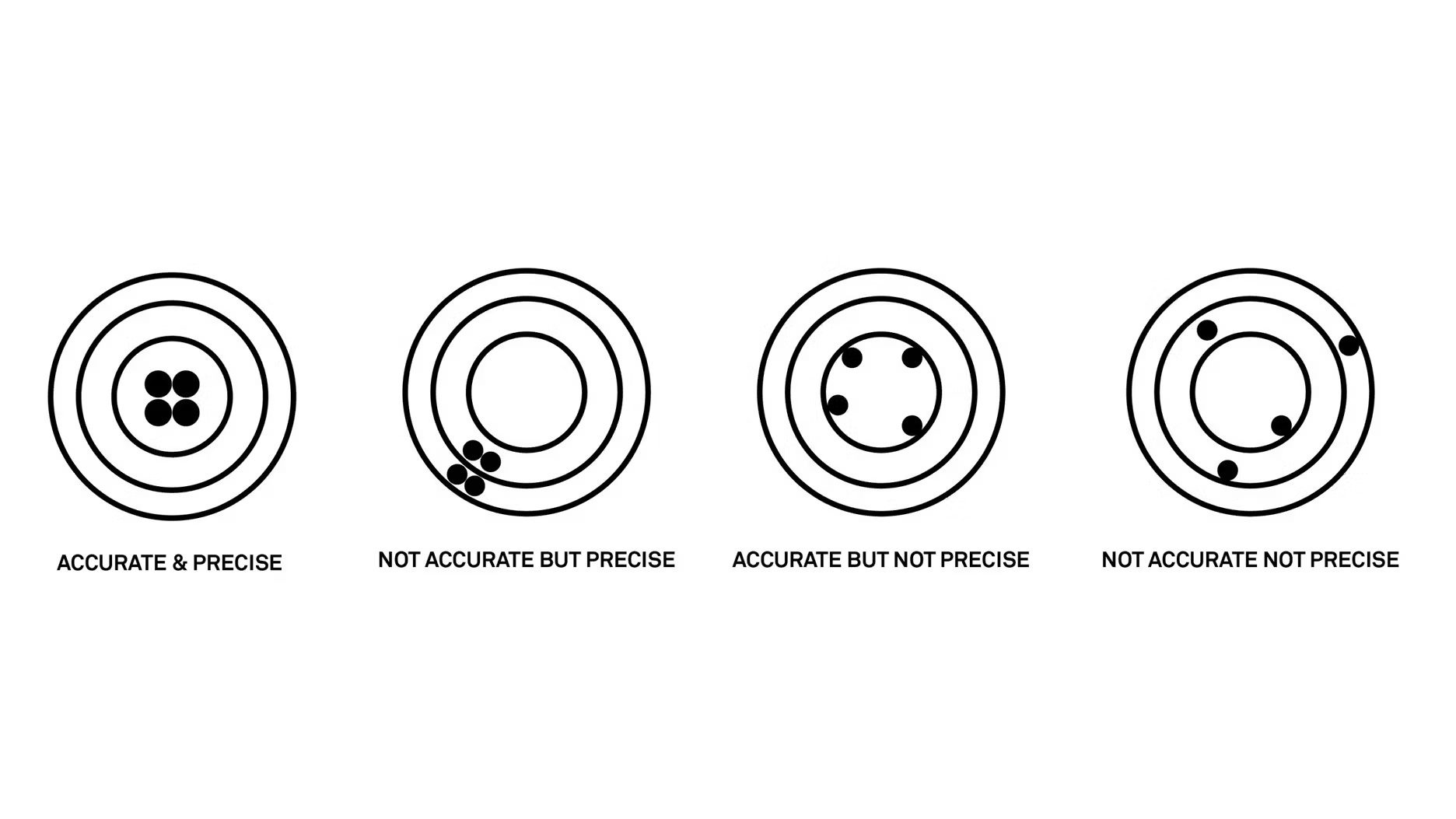
The second assumption is that everything driven off when you dry the sample is water.
In 2015, Dr. Aaron Stancik of CannaSafe Labs tested this assumption by drying cannabis flower in several different ways. He used a very low-temperature vacuum oven (35 °C), periodically testing the change in weight until no further weight loss occurred. This took two to three days.
He also tested samples in a commercial instrument that used a combination of low temperature and desiccated air to dry the sample, then automatically detected the point when the weight stopped changing. He then compared these results with those obtained using a halogen quartz fast loss-on-drying moisture balance.
Results from the vacuum oven and the commercial low-heat drying instrument agreed within ±0.1% VWC. Moisture content measurements from both methods averaged about 3% less than those from the fast loss-on-drying moisture analyzer, suggesting that the fast moisture balance overstates moisture content significantly.
Dr. Stancik postulated that the fast loss-on-drying moisture balance overestimates moisture content due to the volatilization of compounds other than water. Because volatiles make up between 1 and 8% of any cannabis sample, the effects of volatilization cannot be considered insignificant. Not all cannabinoids volatilize at low temperatures, but flavonoids and terpenes certainly do.
In dried bud, fast loss-on-drying moisture balances will almost certainly deliver unstable and artificially high readings. This is of particular concern to the processor who is trying to maximize quality and yield in the cannabis crop while avoiding the risk of mold growth.
Dr. Stancik’s low-temperature method will deliver reliable readings in two to three days, but for those who need faster measurements, we will discuss alternatives in the next section.
Alternatives to loss-on-drying cannabis
Karl Fischer titration is commonly used in the pharmaceutical industry to determine water content. The method is based on the Bunsen Reaction, where water, sulfur dioxide, and iodine react to form sulfuric acid and hydrogen iodide.
Because the reaction consumes water, German researcher Karl Fischer realized that the amount of water in a sample could be calculated based on the concentration of iodine remaining after all water has been consumed. The method can be very precise, but it is expensive, requires expertise, and uses hazardous chemical reagents.
Moisture sorption isotherms provide an alternative method for measuring moisture during the cannabis drying process. This method allows you to determine moisture content in less than five minutes and can be very precise. The method uses a moisture sorption isotherm, a graph that plots the change in water activity as the dried cannabis flower absorbs and desorbs water.
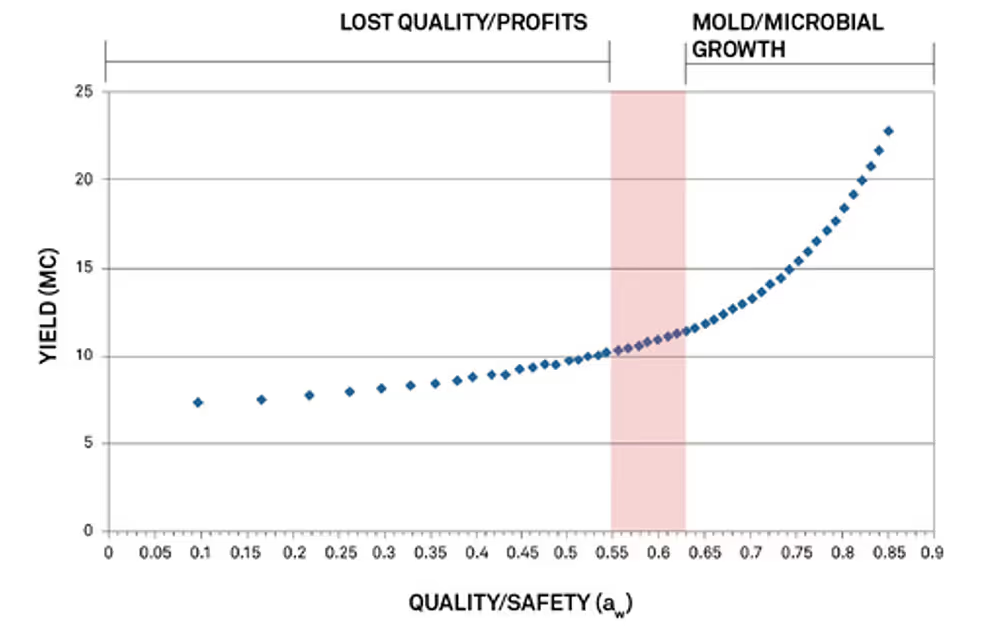
The isotherm is created by drying cannabis buds all the way down and measuring how the moisture content and water activity change during the drying process. This relationship between water activity and moisture content is different for every product, but a specific product’s isotherm can be used to determine that product’s moisture content by measuring its water activity.
Isotherms for several different strains of dried cannabis show that cannabis has a consistent isotherm. This makes it possible to measure water activity on a dried cannabis sample and determine the corresponding moisture content value with a high degree of precision. In testing, this method has proven to be as precise as a low-temperature vacuum oven in determining the moisture content of cannabis.
Continue at: https://aroya.io/education-guides/drying-cannabis
The text above is owned by the site above referred.
Here is only a small part of the article, for more please follow the link
Also see:

 Manostaxx – Industrial Management Consulting


