

Cindy Hall is the owner and chief executive officer of SailRite Company. SailRite builds two models of sailboats that are sold at hundreds of retail boat showrooms throughout the world. At its inception several years ago, the company produced only the Basic model, which is 12 feet long and designed for two sailors. Very few options are available for this model, and the production process is relatively simple. Because many owners of the Basic model wanted to move to a bigger, more sophisticated boat, SailRite developed the Deluxe model two years ago. The Deluxe model is 14 feet long and designed for three sailors. Many additional features are available for this model, and the production process is more complex than for the Basic model. Last year, SailRite sold 5,000 units of the Basic and 1,000 units of the Deluxe.
Although sales of both models increased last year over the year before, company profits have steadily declined. Cindy, the CEO, is concerned about this trend and discusses her concerns with John Lester, the company’s accountant; Mary McCann, the vice president of marketing; and Bob Schuler, the vice president of production.
| Cindy (CEO): | Ever since we introduced the Deluxe model our profits have taken a beating. I need some input on what we should do to get this turned around. |
| Mary (Marketing Vice President): | I’m not sure you can blame our salespeople. We’ve asked them to push the Deluxe model because of the high profit margins, and our sales force has really responded. Sales have steadily increased over the last couple of years, and customers seem to love our sailboats. |
| Bob (Production Vice President): | I don’t think the problem is with our products, and using our current costing system, we make $320 in profit for each Basic model and $850 for each Deluxe model. We need to take a close look at how the cost of each boat is determined. Overhead costs have increased significantly since we started producing the Deluxe boat—to about 45 percent of total production costs—and yet we use only one overhead rate based on direct labor hours to allocate these costs. I don’t see how this can lead to an accurate cost, and I assume we set the price based on the cost of each boat. |
| Cindy: | We certainly considered the cost in our pricing structure. Are you telling me the cost information I have isn’t accurate? |
| John (Accountant): | No, the cost information you have is fine for financial reporting, but not for pricing products. When we were producing only the Basic model, overhead allocation wasn’t an issue. All overhead costs were simply assigned to the one product. Now that we have two products, overhead is allocated based on direct labor hours as Bob stated. We are required to allocate overhead for financial reporting purposes, but I wouldn’t use this cost information for internal pricing purposes. |
| Bob: | I can tell you that the production process for the Deluxe model is much more complicated than the one for the Basic model, so I would expect to see significantly higher costs attached to the Deluxe boat. |
| John: | What I’m hearing is that we need better cost information. I think it’s time we move to a more sophisticated costing system called activity-based costing. Give me time to do some research. Let’s meet next week. |
This dialogue between the accountant and top management emphasizes the importance of having accurate cost information for decision-making purposes. Very few costing systems provide “perfect” product cost information. Overhead (indirect manufacturing costs) can be allocated in a number of different ways and result in a number of different costs for the same product. The goal is to find a system of allocation that best approximates the amount of overhead costs caused by each product. Sophisticated costing systems are expensive, however. Organizations like SailRite must continually ask the question: Will the benefits of having improved cost information outweigh the costs of obtaining the information?
Several options are available to allocate overhead costs. Before we discuss these options, it is important to understand why overhead costs are allocated at all.
3.1 Why Allocate Overhead Costs?
Learning Objective
- Understand why organizations allocate overhead costs to products.
Question: Recall that costs for direct labor and direct materials are easily traced to products. When SailRite produces a sailboat, the direct materials include items such as fiberglass to build the hull, mast, sails, and rope. Direct labor includes the employees building the boat. Accounting for these costs is fairly simple. Indirect manufacturing costs (also called manufacturing overhead or overhead) include electricity to run the factory, rent for the factory building, and factory maintenance. These costs are not easily traced to products and pose a much more complicated challenge for SailRite. Accounting for indirect manufacturing costs typically requires allocating overhead using predetermined overhead rates. Why do managers insist on allocating overhead costs to products?
Answer: Three important reasons that managers allocate overhead costs to products are described in the following:
- Provide information for decision making. Setting prices for products is one example of a decision that must be made by management. Prices are often established based on the cost of products. It is not enough to simply include direct materials and direct labor. Overhead must be considered as well.
- Promote efficient use of resources. Several different activities are performed to produce a product, such as purchasing raw materials, setting up production machinery, inspecting the final product, and repairing defective products. All of these activities consume resources (consuming resources is another way of stating that a cost is associated with each of these activities). If products are charged for the use of these activities, managers will have an incentive to be efficient in utilizing the activities.
- Comply with U.S. Generally Accepted Accounting Principles (U.S. GAAP). U.S. GAAP requires that all manufacturing costs—direct materials, direct labor, and overhead—be assigned to products for inventory costing purposes. This requires the allocation of overhead costs to products.
Key Takeaway
- Overhead costs are allocated to products to provide information for internal decision making, to promote the efficient use of resources, and to comply with U.S. Generally Accepted Accounting Principles.
Review Problem 3.1
For each scenario listed as follows, identify which of the three important reasons presented in this section best explains why managers choose to allocate overhead costs to products.
- Financial statements are prepared for the annual report that is provided to shareholders.
- Management is considering the addition of a new product line.
- The production manager decides to decrease the frequency of raw materials purchases to reduce the allocated portion of the purchasing department’s costs.
- Profits are calculated for each product so management can decide which products to promote.
- Quality control inspections are reduced to cut down on the allocated portion of the quality control department’s costs.
- Financial statements are prepared for the company’s bondholders.
- Management asks for cost information to assist in bidding for a contract.
Solutions to Review Problem 3.1
- Comply with U.S. GAAP
- Provide information for decision making
- Promote efficient use of resources
- Provide information for decision making
- Promote efficient use of resources
- Comply with U.S. GAAP
- Provide information for decision making
3.2 Approaches to Allocating Overhead Costs
Learning Objective
- Compare and contrast allocating overhead costs using a plantwide rate, department rates, and activity-based costing.
Question: Managers at companies such as Hewlett-Packard often look for better ways to figure out the cost of their products. When Hewlett-Packard produces printers, the company has three possible methods that can be used to allocate overhead costs to products—plantwide allocation, department allocation, and activity-based allocation (called activity-based costing). How do managers decide which allocation method to use?
Answer: The choice of an allocation method depends on how managers decide to group overhead costs and the desired accuracy of product cost information. Groups of overhead costs are called cost pools. For example, Hewlett Packard’s printer production division may choose to collect all factory overhead costs in one cost pool and allocate those costs from the cost pool to each product using one predetermined overhead rate. Or Hewlett Packard may choose to have several cost pools (perhaps for each department, such as assembly, packaging, and quality control) and allocate overhead costs from each department cost pool to products using a separate predetermined overhead rate for each department. In general, the more cost pools used, the more accurate the allocation process.
Plantwide Allocation
Question: Let’s look at SailRite Company, which was presented at the beginning of the chapter. The managers at SailRite like the idea of using the plantwide allocation method to allocate overhead to the two sailboat models produced by the company. How would SailRite implement the plantwide allocation method?
Answer: The plantwide allocation method uses one predetermined overhead rate to allocate overhead costs.Regardless of the approach used to allocate overhead, a predetermined overhead rate is established for each cost pool. The predetermined overhead rate is calculated as follows (from Chapter 2 “How Is Job Costing Used to Track Production Costs?”):
When activity-based costing is used, the denominator can also be called estimated cost driver activity. One cost pool accounts for all overhead costs, and therefore one predetermined overhead rate is used to apply overhead costs to products. You learned about this approach in Chapter 2 “How Is Job Costing Used to Track Production Costs?” where one predetermined rate—typically based on direct labor hours, direct labor costs, or machine hours—was used to allocate overhead costs. (Remember, the focus here is on the allocation of overhead costs. Direct materials and direct labor are easily traced to the product and therefore are not a part of the overhead allocation process.)
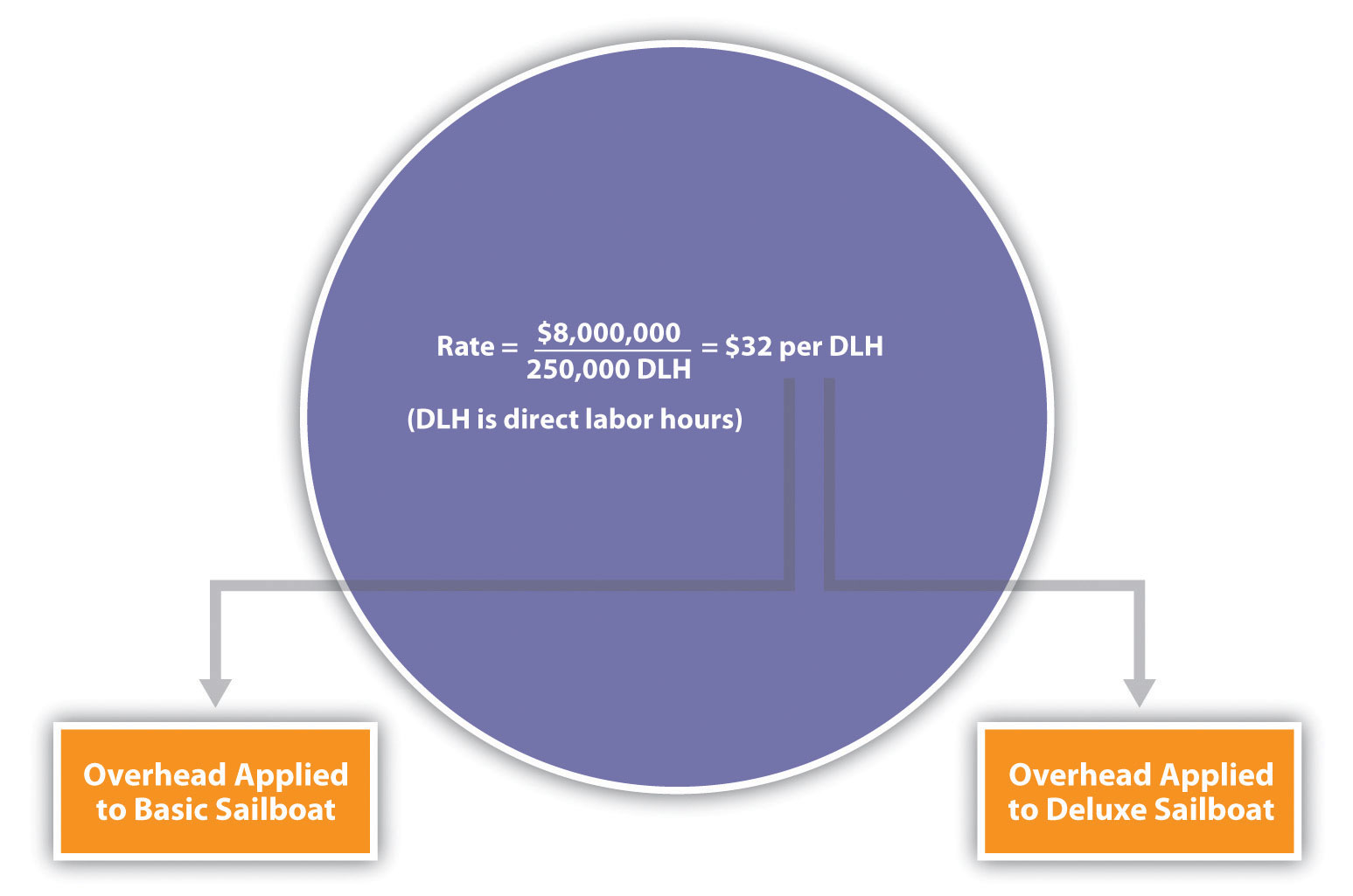
Using SailRite Company as an example, assume annual overhead costs are estimated to be $8,000,000 and direct labor hours are used for the plantwide allocation base. Management estimates that a total of 250,000 direct labor hours are worked annually. These estimates are based on the previous year’s overhead costs and direct labor hours and are adjusted for expected increases in demand the coming year. The predetermined overhead rate is $32 per direct labor hour (= $8,000,000 ÷ 250,000 direct labor hours). Thus, as shown in Figure 3.1 “Using One Plantwide Rate to Allocate SailRite Company’s Overhead”, products are charged $32 in overhead costs for each direct labor hour worked.
Figure 3.1 Using One Plantwide Rate to Allocate SailRite Company’s Overhead
Product Costs Using the Plantwide Allocation Approach at SailRite
Question: Assume SailRite uses one plantwide rate to allocate overhead based on direct labor hours. What is SailRite’s product cost per unit and resulting profit using the plantwide approach to allocate overhead?
Answer: The calculation of a product’s cost involves three components—direct materials, direct labor, and manufacturing overhead. Assume direct materials cost $1,000 for one unit of the Basic sailboat and $1,300 for the Deluxe. Direct labor costs are $600 for one unit of the Basic sailboat and $750 for the Deluxe. This information, combined with the overhead cost per unit, gives us what we need to determine the product cost per unit for each model.
Given the predetermined overhead rate of $32 per direct labor hour calculated in the previous section, and assuming it takes 40 hours of direct labor to build one Basic sailboat and 50 hours to build one Deluxe sailboat, we can calculate the manufacturing overhead cost per unit. Manufacturing overhead cost per unit is $1,280 (= $32 × 40 direct labor hours) for the Basic boat and $1,600 (= $32 × 50 direct labor hours) for the Deluxe boat. Combine the manufacturing overhead with direct materials and direct labor, as shown in Figure 3.2 “SailRite Company Product Costs Using One Plantwide Rate Based on Direct Labor Hours”, and we are able to calculate the product cost per unit.
Figure 3.2 SailRite Company Product Costs Using One Plantwide Rate Based on Direct Labor Hours
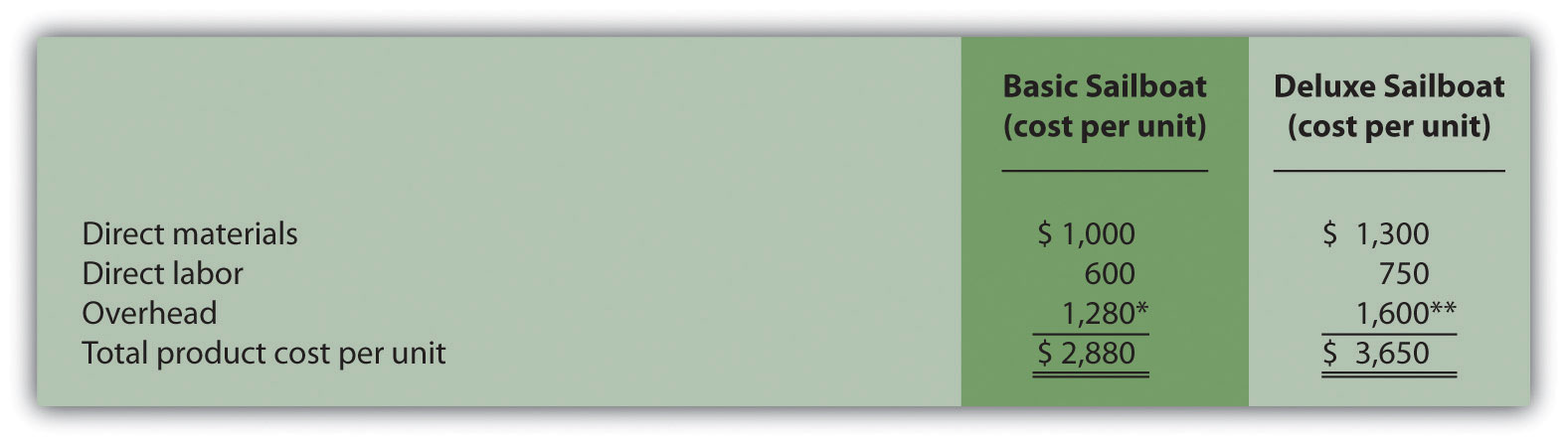
*$1,280 = 40 direct labor hours per unit × $32 rate.
**$1,600 = 50 direct labor hours per unit × $32 rate.
The average sales price is $3,200 for the Basic model and $4,500 for the Deluxe. Using the product cost information in Figure 3.2 “SailRite Company Product Costs Using One Plantwide Rate Based on Direct Labor Hours”, the profit per unit is $320 (= $3,200 price – $2,880 cost) for the Basic model and $850 (= $4,500 price – $3,650 cost) for the Deluxe. Recall from the opening dialogue that SailRite’s overall profit has declined ever since it introduced the Deluxe model even though the data shows both products are profitable.
Question: The managers at SailRite like the idea of using the plantwide allocation approach, but they are concerned that this approach will not provide accurate product cost information. Although the plantwide allocation method is the simplest and least expensive approach, it also tends to be the least accurate. In spite of this weakness, why do some organizations prefer to use one plantwide overhead rate to allocate overhead to products?
Answer: Organizations that use a plantwide allocation approach typically have simple operations with a few similar products. Management may not want more accurate product cost information or may not have the resources to implement a more complex accounting system. As we move on to more complex costing systems, remember that these systems are more expensive to implement. Thus the benefits of having improved cost information must outweigh the costs of obtaining the information.
Continue at: https://saylordotorg.github.io/text_managerial-accounting/s07-how-does-an-organization-use-a.html
The text above is owned by the site above referred.
Here is only a small part of the article, for more please follow the link
Also see:

 Manostaxx – Industrial Management Consulting


