Manufacturing Costs
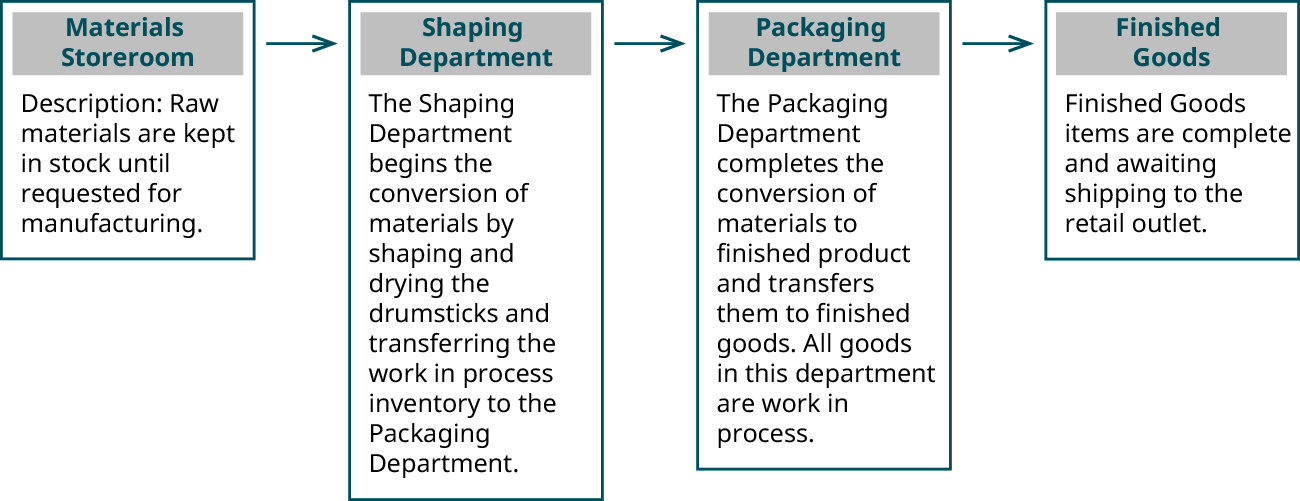
Manufacturing costs or product costs include all expenses required to manufacture the product: direct materials, direct labor, and manufacturing overhead. Since process costing assigns the costs to each department, the inventory at the end of the period includes the finished goods inventory, and the work in process inventory for each manufacturing department. For example, using the departments shown in Figure 8.62, raw materials inventory is the cost paid for the materials that remain in the storeroom until requested.
While still in production, the work in process units are moved from one department to the next until they are completed, so the work in process inventory includes all of the units in the shaping and packaging departments. When the units are completed, they are transferred to finished goods inventory and become costs of goods sold when the product is sold.
Visit us at: C O S T M A E S T R O

When assigning costs to departments, it is important to separate the product costs from the period costs, which are those that are typically related with a particular time period, instead of attached to the production of an asset. Management often needs additional information to make decisions and needs the product costs further categorized as prime costs or conversion costs (Figure 8.63). Prime costs are costs that include the primary (or direct) product costs: direct material and direct labor. Conversion costs are the costs necessary to convert direct materials into a finished product: direct labor and manufacturing overhead, which includes other costs that are not classified as direct materials or direct labor, such as plant insurance, utilities, or property taxes. Also, note that direct labor is considered to be a component of both prime costs and conversion costs.
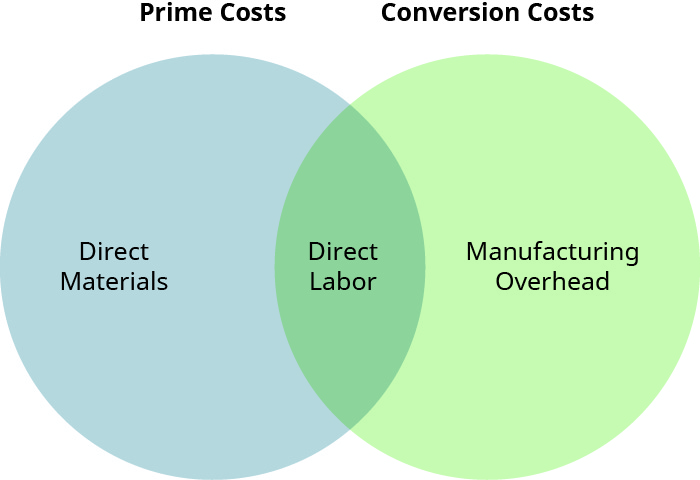
Job order costing tracks prime costs to assign direct material and direct labor to individual products (jobs). Process costing also tracks prime costs to assign direct material and direct labor to each production department (batch). Manufacturing overhead is another cost of production, and it is applied to products (job order) or departments (process) based on an appropriate activity base.
Selling and Administrative Expenses
Selling and administrative (S&A) expenses are period costs, which means that they are recorded in the period in which they were incurred. Selling and administrative expenses typically are not directly assigned to the items produced or services provided and include costs of departments not directly associated with manufacturing but necessary to operate the business. The selling costs component of S&A expenses is related to the promotion and sale of the company’s products, while administrative expenses are related to the administration of the company. Some examples of S&A expenses include marketing costs; administration building rent; the chief executive officer’s salary expense; and the accounting, payroll, and data processing department expenses.
These general rules for S&A expenses, however, have their exceptions. For example, some items that are classified as overhead, such as plant insurance, are period costs but are classified as overhead and are attached to the items produced as product costs.
The expense recognition principle is the primary reason to separate the costs of production from the other expenses of the company. This principle requires costs to be recorded in the period in which they are incurred. The costs are expensed when matched to the revenue with which they are associated; this is commonly referred to as having the expenses follow the revenues.
Period costs are expensed during the period in which they are incurred; this allows a company to apply the administrative and other expenses shown on the income statement to the same period in which the company earns income. Under generally accepted accounting principles (GAAP), separating the production costs and assigning them to the department results in the costs of the product staying with the work in process inventory for each department. This follows the expense recognition principle because the cost of the product is expensed when revenue from the sale is recognized.
Equivalent Units
In a process cost system, costs are maintained by each department, and the method for determining the cost per individual unit is different than in a job order costing system. Rock City Percussion uses a process cost system because the drumsticks are produced in batches, and it is not economically feasible to trace the direct labor or direct material, like hickory, to a specific drumstick. Therefore, the costs are maintained by each department, rather than by job, as they are in job order costing.
How does an organization determine the cost of each unit in a process costing environment? The costs in each department are allocated to the number of units produced in a given period. This requires determination of the number of units produced, but this is not always an easy process. At the end of the accounting period, there typically are always units still in production, and these units are only partially complete. Think of it this way: At midnight on the last day of the month, all accounting numbers need to be determined in order to process the financial statements for that month, but the production process does not stop at the end of each accounting period. However, the number of units produced must be calculated at the end of the accounting period to determine the number of equivalent units, or the number of units that would have been produced if the units were produced sequentially and in their entirety in a particular time period. The number of equivalent units is different from the number of actual units and represents the number of full or whole units that could have been produced given the amount of effort applied. To illustrate, consider this analogy. You have five large pizzas that each contained eight slices. Your friends served themselves, and when they were finished eating, there were several partial pizzas left. In equivalent units, determine how many whole pizzas are left if the remaining slices are divided as shown in Figure 8.64
- Pie 1 had one slice
- Pie 2 had two slices
- Pie 3 had two slices
- Pie 4 had three slices
- Pie 5 had eight slices
Together, there are sixteen slices left. Since there are eight slices per pizza, the leftover pizza would be considered two full equivalent units of pizzas. The equivalent unit is determined separately for direct materials and for conversion costs as part of the computation of the per-unit cost for both material and conversion costs.

Continue at: https://psu.pb.unizin.org/acctg211/chapter/process-costing-overview/
The text above is owned by the site above referred.
Here is only a small part of the article, for more please follow the link
Also see:

 Manostaxx – Industrial Management Consulting